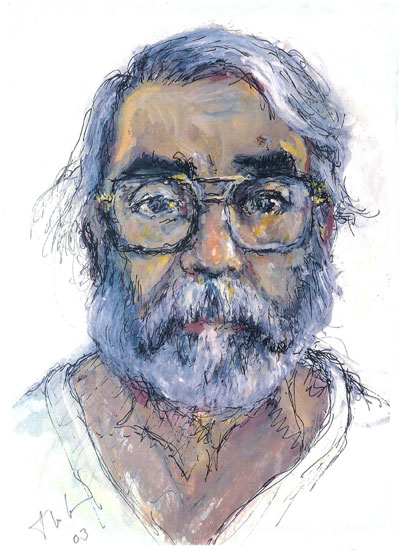
About the Artist/Author: Markand Thakar

Self PortraitThe autobiography of an artist is his lifework - which consists of the benchmarks that novelists, critics and art historians like to utilize as a takeoff point, if the artist is prominent enough, for their own writings - which is then used to invent a romanticized history for the mostly-prosaic one of the real-life artist-protagonist. No written account of anything but the everyday details that make up an artist's life - should be required when observing a work of art: the art should speak for itself. But, by one not divulging the details that make up one's life-story raises the possibility that an invented one will prevail - one with untold, imaginary, unflattering or romanticized skeletons in an artist's closet. Therefore, on the foolhardy assumption that my work might please the powers that be, I feel compelled to turn the light on in my closet, and give my history - one that is as true as I know it to be. But, since only folks running for president of the United States are required to tell truthfully of their monetary and sexual doings, no mention of either will be made.

I've been asked, on numerous occasions, to explain the origins of my name and of my antecedents - and, just how did my parents, being of such different backgrounds, manage to meet? It has become obvious, that in this day of the American hyphenate, merely stating that I was born in New York City, on the 4th of July, in the fateful year, 1929 - and being the sixth child of a father born in India, and a mother born in Belgium, makes for an insufficient life history - and will not satisfy the curiosity of the inquisitive, potential art-museum-goer. Since my stating that I consider myself an American - and only an American: an American kid, born and bred in New York City during the Great Depression and the pre-, during, and post-WWII years - is no longer sufficient in Twenty-first century America: a land that has more people claiming to be hyphenates than during the pre-depression years, when the anti-immigration laws were enacted, I will elaborate.

Self PortraitMy name: Markand Thakar, has Indian roots. My father's Kshatriya, Hindu, Indian family owned a shipping line that travelled between Kuchchh, Mandvi and Zanzibar. My father, Nainsink, Mainsink Thakar, Anglicized his name to Thacker - when taking out US citizenship - which was a condition of his serving as a censor in obscure and exotic languages with the US Censors during WWI. After the enactment of the racist immigration laws in the early 1920's, he made plans to return to India - as a Thakar. But, due to the effects of the Great Depression, his ill health and eventual death in 1937 (when I was eight years old), he never did - and, I was not to set foot in India until 1991.

My father was born in 1883 in Gujarat, India. Upon the death of his parents, he sold the remnants of his family's firm, and shortly after the turn of the century arrived on America's West Coast - by way of Bali and Japan. Then, in New York City, prior to America's entry into WWI, he met my mother: ten years younger, a college student, born in Belgium, lived for a short period in South Africa during the Boer War, and reared and educated in Holland. They met at a function sponsored by Columbia-cum-International House, where my father resided. My father, Nainsink, Mainsink Thakar, was a practicing Hindu. My mother, Lena Gottlich, an Atheist, was born in 1893, in Belgium of diamond-dealing, European, Orthodox Jewish parents - who disowned, disinherited and considered her excommunicated for having married my Hindu father.

After the drafting, during WWII, of my three older brothers, I began working as a gofer at a haberdashery that furnished the uniforms for Columbia's Navy ninety-day-wonders, then worked as a soda jerk - during which time I dropped out of High School. On July 18, 1946, shortly after I turned seventeen, I enlisted in the Regular Army and served for about a year in the post-WWII occupation of Japan. As a result, I joined my three older brothers as WWII veterans (all of us having served during WWII's emergency years).

After my discharge, and over the years, I used up my GI Bill schooling allowance - during which time I worked at numerous jobs: soda jerk, bank page, RR dock worker, apprentice machinist, model maker - all the while, and from then on, I was more or less involved in the making of art. Then, from late 1953, before selling my business in 1974, I supported my wife, Betty Huber (a German Baptist, born in Meriden, Connecticut, in1926, who was in the process of obtaining a PhD.) and our three children as a licensed customhouse broker and registered foreign freight forwarder. My wife of over half a century (now deceased), after obtaining her PhD. carried much of the burden of supporting the family - from 1974 on.

In late 1960's and early 1970's, I exhibited in Soho and small college museums throughout the country. Before realizing that art organizations are as politically corrupt as most governments, I associated with, or became a member of the National Arts Club, Artists Fellowship, Art Students League (Treasurer), Alliance of Figurative Artists, American Fine Arts Society, Salmagundi Club. However, since the mid-1970's, I've disassociated myself from virtually all dealings with these organizations.

Markand Thakar.