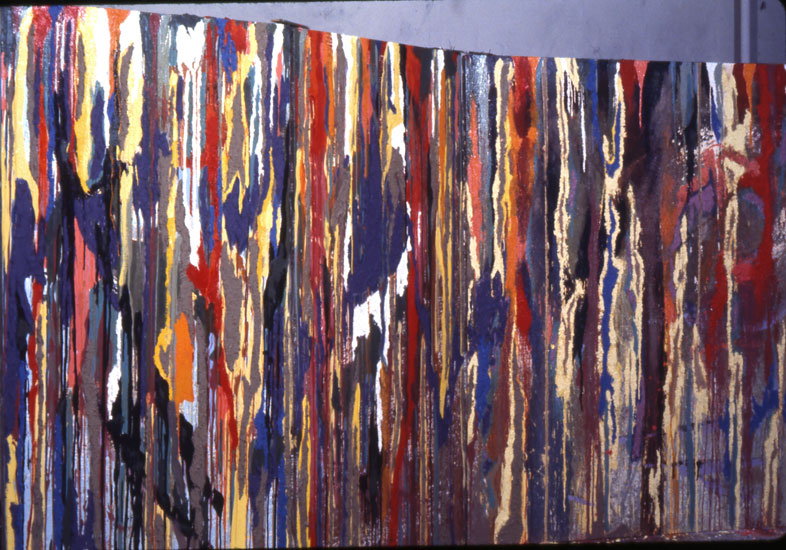
Stochastics

Fantasy Abstract

Stochastics

Most folks were aware of the iconoclastic doings of Moslem fundamentalists in Taliban-controlled Afghanistan: the destruction of huge fourteen-hundred-year-old stone carvings of The Buddha. Visitors to Mumbai are, no doubt, aware of the mutilation, by Portugal's inquisition-time Catholics, of India's fabulous stone carvings at Elephanta. All those knowing of Roman history would also be aware of the destruction of the statuary depicting the Gods of the Mediterranean-centered Polytheist religions by early Christianized Jews and Gentiles. And, it would take a blind man, visiting any major art museum, to ignore the defacing and destruction of ancient Egypt's statuary by members of one or the other groupings of religious fanatics (all in an effort to make those Gods impotent). So, obviously, in comparison, the permanent-misplacing, stealing or destruction of a thirty foot by six foot, nine-part painting that was on extended loan to a religion-run institution in New Jersey, can hardly be considered a major loss to humanity's cultural heritage. Nonetheless, the writer believes the happenstances surrounding that loss might be of interest to both artists and Atheists, especially those desiring to confirm their beliefs in the first case, that artists are a vulnerable lot; and in the second, that, "do unto others" is a touted basic tenet: only too rarely practiced by the fundamentalist followers of the formal Our-God-is-the-only-God religions few of whom are known to adhere to the spiritual and truly moral aspects non-believers have been told that they adhere to.

In the spring of 1968, I rented a work studio (a floor-through space of about 1600 square feet) located on 14th Street near Sixth Avenue. Until then it had been occupied by a hippie couple. Since they had skipped out owing the owner for several months rent, and left a mess (before attempting to rent it out, the owner found it necessary to remove a dumpster-load of debris) and I seemed a more solid-citizen-type artist (I was self-employed and had a bona fide residence) the owner was more than happy to rent the space to me. The rent was one hundred and eighty-five dollars per month, and included gas, electric and afternoon use of a freight elevator to my third floor studio. By the year 2008, it would be difficult to believe that such rents ever existed in Manhattan.

In 1970, the owner, a middle-aged diamond merchant (a very decent man a refugee from Nazism) with offices on 47th Street mentioned that it would be wise for me to exercise the option, with a ten dollar a month increase, to extend my lease for two more years. He said he could be selling the building, and implied that the new owner might be far more aggressive than he, in trying to up the rent.

In time, the owner of the building sold it to the new proprietor of the ground-floor, luggage-and-stuff retail store. And, four months before my two-year option was up, the new owner, a recently-arrived immigrant from Israel, agreed to a fifty dollars per month increase. However, the owner from whom I had originally rented my studio proved to be prescient: before a new lease was signed, the new owner, the Israeli, phoned me to say that he had changed his mind, and that he now wanted to double the then-existing rent. I reminded him of our prior agreement, but the new owner said it wasn't binding. I told him I hoped it would make him a rich man, and looked for a new space. One was found for two hundred dollars a month which was smaller, but better located.

Now then, the reason for this bit of reportage: back in 1969, I had an exhibition in my 14th Street studio of my most recent work: consisting of nine paintings: eight of which were six by three feet (or three by six feet), and one was six foot square; they were intended to hang together: making a single thirty foot by six foot work which I titled: Stochastics.

A year or so before starting the paintings, while working on a triptych: a realistic work that was going nowhere (pictured elsewhere on this site), I, along with my wife, attended a performance by the New York City Ballet. It included a new Balanchine ballet choreographed to music by the mathematician-cum-composer, Xenakas; it was titled Stochastics (chance). Balanchine, being such a great choreographer, had given form to a series of random sounds, or noises, if you will. Balanchine's ability to give structure to the bloops, zips and plops of Xenakas's stochastic music, was inspiring. I applied the concept of chance to the triptych that I was working on. It was then, while finishing the triptych that led to the decision to create a completely non-objective painting: one that would utilize the techniques I had developed when working on the triptych ergo, my "Stochastic" paintings.

Besides working in my studio, I spent a few hours a day in my downtown office where, as a self-employed, licensed Customhouse Broker and Registered Foreign Freight Forwarder, I earned enough to support my family provided I was mindful of my art-oriented expenses: and studio rent was the most significant.

Due to my decision to move to a smaller, and more affordable studio, I asked my agent (who had arranged for touring exhibitions of my ink-wash drawings) about the possibility of one of the colleges where my work had been exhibited, being interested in displaying (for an undetermined period) the thirty-foot Stochastic work. Within a few days, the agent advised me that there was a college in Caldwell, North Jersey that might be interested, and suggested that I send slides and a diagram of the work to a certain Sister Gerardine, who was the head of the college's art department. She had told them that a large students' lounge-cum-dining hall had recently been constructed and it had a space suitable for such a large painting. After viewing the slides and diagram, Sister Gerardine called me and said she'd be delighted to display the work. Thereupon, Nance visited the college: there, he saw how wonderful the space really was in addition, he saw that there were huge windows facing the small, but well kept campus. Since it was obvious that only an exhibition of the work in a decent museum would have afforded the work greater exposure, a verbal agreement was readily reached.

I had advised Sister Gerardine that moving it would require a van. Nevertheless, she arrived at his studio, by herself, in a station wagon. No doubt she believed that God would provide. And He (She, They or It) did. I worked my tail off but, so did the good sister. Since not all eight smaller individual pieces could fit in the vehicle, some, along with the largest piece were tied down to the vehicle's baggage rack. Later, upon seeing how she had displayed the work, I felt that my efforts were well rewarded.

Over the years, Sister Gerardine came to my studio to pick up works for solo exhibits in the college's art-school gallery. Sister Gerardine was one of the most decent people I new (and not only because she liked my work or that she showed me much respect as an artist). Although this didn't change my general attitude towards religion (after all, I am a committed Atheist), I grew to respect her for the fine woman that she was. And, throughout the ordeal that followed, she never did a thing to alter my opinion of her.

Along with the passage of time went a spiraling increase in rents for commercial space. As a result, after my children grew up and left home, I turned my living room into a studio. Though, it forced me to do so with much restraint. So, for a number of years, being a fairly experimental artist, I did a series of paintings based on earlier, more-realistic and personal works. In them, I attempted to disregard the concept of chiaroscuro and stress flat, pure color as well as a line that might vary in width. The last exhibit I had at the college was back in the late 1980s. And it included those color-and-line-stressing works, along with the academic-type paintings on which they were based along with all nine stochastic paintings. Before returning the work, Sister Gerardine asked if I'd like to have the Stochastic paintings returned along with the other works. I told her that: since they would probably be re-hung at the college, and space was tight in my studio, that the paintings might just as well be left at the college.

A few years later, I decided that it was time to have a retrospective of my work. So, I called Sister Gerardine (although she no longer headed up the art department) to arrange to have the Stochastic paintings delivered to me. And, that's when, after the passage of a week or two, I was advised that the paintings could not be located.

Eventually, after a month or so, the new folks, those who followed the nuns in the control of the art department (MFAs and lay Catholics who, as a rule, can be a narrow-minded lot), advised Sister Gerardine that the paintings could not be found. The conclusion was that the paintings were lost, stolen or destroyed with emphasis on destroyed.

What was I to do? It appeared that Sister Gerardine was being pressured by the college to claim that the works could have been delivered to me. But, she wrote me, stating that she had not returned the paintings to me. It was obvious to me that she was in a fix. The college was denying all responsibility. Yet, she indicated to me that she was aware of the college's liability. The upshot was, I would have been required to sue the college.

There was only the slimmest of chances of a New York Atheist suing and winning a law suit against a Catholic organization in New Jersey. And, I was reluctant to expend the time or involve the very decent Sister Gerardine in it all of which would have been required if I were to engage in a law suit; so, I decided to forget the whole thing. After all, none of it would have brought the paintings back to life.

From then on, memories and the few photos that I have of them (which the reader can find on this web site), will have to suffice.

Markand Thakar